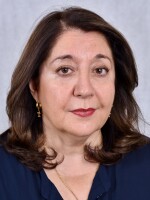
BEIRUT — In a makeshift gym in the Burj al-Barajneh refugee camp, the participants in this martial arts class are unlearning much of what they have been taught about how girls and women should behave.
It's the end of a two-month course in Brazilian jiu jitsu - a form of the Japanese martial art - and the small space rings out with yells and the sound of shuffling as coach Mirella Atallah drills her students on how to get leverage against a much stronger opponent.

Atallah, though, doesn't consider it just self-defense.
"For me it's important to call it women's empowerment in public spaces, " she says.
"After two weeks I felt I was changing - not just in sports but my mental health and everything," says Aisha Saqqa, 18, and a first-year business management student in college. "Mirella told us to act differently."
That includes noticing their surroundings in public instead of striving to not be noticed, keeping their heads up and making eye contact. It also includes using their voices, a challenge for some girls raised to be quiet.

"I had a lady in the program, she actually tried to scream and to scream for help and she couldn't - her voice wouldn't go out," Atallah says.
Saqqa, who wants to start a perfume business, wears a pale pink hijab covering her hair and a loose green shirt, and plans to start a perfume business after college. She speaks passionately about wanting to improve herself, to join every club she can and to become skilled at public speaking.
Everyone in the room is overcoming adversity - starting with being born in one of Lebanon's Palestinian refugee camps to families who fled or were forced out of their homes with the creation of Israel in 1948 and never allowed back.

In a country that has seen little but war and economic crisis in the past few decades, almost every social and economic problem is magnified in the camps.
Atallah herself is a role model. Raised in a poor Lebanese family and bullied at school, she worked her way through university and finally made her way to Kuwait and then Canada.
"I was not like the other girls - never looked like them, never wore clothes like them," she says of her childhood. "We were not doing well financially so we never had the opportunity to buy new stuff and be cute."

When she wanted to learn judo like her brother, her parents told her it was unsuitable for girls.
Atallah now is 48. She moves with confidence and is so fit and healthy she looks more than a decade younger. But she struggled to get there.
"Jiu jitsu gave me a voice," she says. I was very shy and then when I started jiu jitsu I felt empowered, I felt strong. I felt I could do anything I want."
A new start

Working multiple jobs in addition to studying, it took her eight years to finish university in Lebanon. After graduating in 2005, she moved to Kuwait and worked in marketing. She says her weight there reached 275 pounds and her body 'shut down'. She was on constant medication and had to use crutches to walk.
"When I moved to Canada I said this is my chance to change," she says. "I was like 'no, no, no. This is not me. I am not going to be that person.'"
Atallah says she started yoga and meditation. And those practices led her eventually to the martial arts
"I went to the gym and started kickboxing and never skipped even in the heaviest snowstorm," she says of her time in Montreal. "I lost a lot of weight and I felt so light on my feet."
Eventually she made her way to a Brazilian form of jiu jitsu which, unlike the traditional Japanese version, does not use sticks. On the mat she heard stories from people who said the sport helped them overcome drug addiction and recover from abusive backgrounds.
Six months later she entered her first competition and won. She is now a Brazilian jiu jitsu black belt - the first Lebanese woman to attain that level - and a certified yoga teacher.
Creating communities

Before the class starts, Atallah is sitting in a Beirut cafe with flowers and outdoor tables - a side of the city often featured in influencer social media posts. A server offers hibiscus and mulberry vanilla kombucha.
Just a short walk away is the entrance to the camp, and another world.
"The situation of girls and women in Lebanon is different than what you see superficially," Atallah says. "It's not us sitting in this cafe. It's not what you see downtown. Only about ten percent of people are able to live that life."

For many women, particularly those in the camps, life is more about grinding poverty and the ever-present danger of being robbed or assaulted in the street. At home, she says, many girls are beaten and bullied by their mothers as well as their fathers.
"It's very common for them to hit and push," she says. "One girl - her mother burned her with an iron."
She speaks of one girl, 15, whose father pulled her out of school, forced her to cook and clean for the family and prevented her from going out or speaking to people. She says it was the friends the girl had made in jiu jitsu class who reached out for help for her.

"Something I do with all the programs is create small communities," Atallah says. "I want them to bond so that at least if something happens you have support so that you don't feel alone."
Without safe public transportation, women and girls can face harassment and risk rape when going out, particularly at night.
"So many of the women I was teaching don't go out when it's dark. They stay home," Atallah says. "It's like a cycle. You limit the women from going out. They can't go to the gym…their health deteriorates, their mental health is not there."

She says when they first join the class many of the girls are so uncomfortable with their bodies, they find it difficult to do basic moves, such as squats. Atallah eases them into it.
Atallah works with non-governmental organizations to run free classes for migrant workers, girls and women in refugee camps and those in the LGBT community - among the most marginalized and vulnerable in society. She estimates she has taught about 1,500 women and girls all over the world, including in Syria and Pakistan this year.
The students have ranged in age from 12 to 83.
In the small gym in the Beirut refugee camp, Fatima Mohammad, 21, a substitute teacher and graphic designer, says the class has given her more confidence.
"When I started jiu jitsu my way of thinking changed a lot, not only physically but also mentally," she says.

Atallah breaks away from the moves on the mat to go around the circle, asking each of the 16 girls and women what they would change about the camp if they could. Some mention removing weapons, others talk about planting trees or more access to exercise. Atallah encourages them to imagine those changes.
"You know when you have a pool of water and you throw a stone in it," to create ripples, Atallah tells the women and girls. "We are the stones."
Copyright 2026 NPR